
Municipal Utility District (MUD) vs PID vs HOA
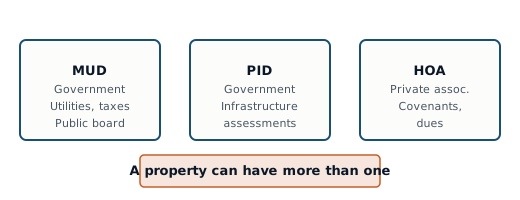
These three labels show up on Texas listings and closing packets, and they are not interchangeable. A Municipal Utility District (MUD) is a form of local government. A Public Improvement District (PID) is a different assessment tool often used for public improvements. An HOA is a private association. A single property can have more than one of these at the same time.
They can overlap
Seeing “MUD” on a listing does not mean there is no HOA. Seeing an HOA does not mean there is no PID. Always inventory every entity on the tax bill, resale certificate, and notices.

Compare carefully. Overlap is common.
A single property can sit in a MUD, a PID, and an HOA at the same time. Use the table below as a map of concepts, not a verdict.
Comparison table
Neutral comparison. No winners. A property can have more than one.
| Question | Municipal Utility District (MUD) | Public Improvement District (PID) | Homeowners Association (HOA) |
|---|---|---|---|
| What it is | Political subdivision / special district that can provide utilities and related services | A district/assessment mechanism (often city-created) used to fund public improvements in a defined area | Private organization that governs community covenants and shared amenities/rules |
| Who governs | District board of directors (public) | Typically tied to municipal/public process for the PID (details vary) | Board elected under association governing documents (private) |
| How paid | Ad valorem MUD tax; separate utility bills for service | Assessments sometimes called “PID tax” in casual speech; often collected through tax bill or assessment process | Dues/fees per CC&Rs and association billing |
| Typical purpose | Water, sewer, drainage, and other authorized district facilities | Finance public improvements in a defined project area | Enforce covenants; manage shared amenities/rules |
| Does it end? | District debt and rates evolve; do not assume a simple consumer end date | Assessment plans can have schedules; read the PID documents for that project | HOA usually continues with the community; dissolution is uncommon and document-specific |
| Common confusion | Mixing MUD tax with the monthly water bill | Folding PID assessments into “the MUD tax” | Treating an HOA as if it were a government taxing unit |
Scroll sideways for all columns. First column stays visible when possible.
Under-table nuance
What is a PID in real estate?
A Public Improvement District (PID) is commonly used to finance public improvements (roads, landscaping, infrastructure, and similar project items depending on the PID). Buyers often search “what is pid tax” when they see an assessment line. Treat PID amounts as their own stream. Do not fold them into “the MUD tax” in your head.
MUD and PID tax on one property
Yes, both can apply. Your diligence list should include Municipal Utility District notices and PID disclosure/assessment documents when a PID exists. We do not rank which combination is “better.”
MUD vs HOA
MUDs are governments. HOAs are private associations. One builds/operates certain public infrastructure and can tax. The other enforces covenants and collects dues. You can have both.