
What is a Municipal Utility District (MUD)?
A Municipal Utility District (MUD) is a political subdivision of the State of Texas created to provide certain public services, most often water, wastewater (sewer), and drainage, within defined boundaries. In everyday real estate talk, people shorten that to “MUD.” On this site we always mean Municipal Utility District, not a game or slang term.
Campaign overview
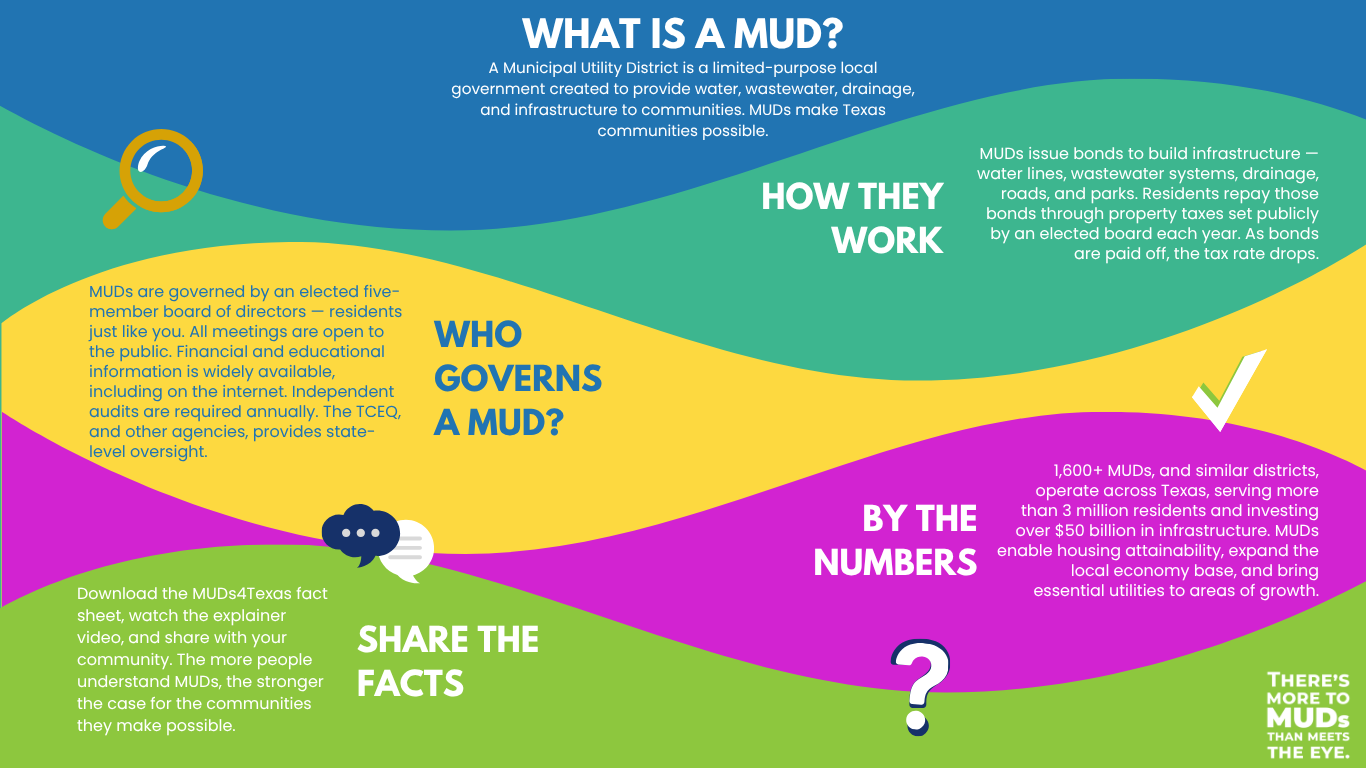
A one-page visual from the MUDs 4 Texas campaign covering what a MUD is, who governs it, how bonds work, and the scale of MUDs in Texas.
Video overview
Video coming soon
What is a Municipal Utility District?
In plain language
Think of a MUD as a small local government focused on utility and related infrastructure for a specific area. Many Texas neighborhoods, especially master-planned and new-construction communities outside older city cores, sit inside a MUD. The district can levy property (ad valorem) taxes and may charge for utility service. Those are different money streams. We explain taxes on the MUD taxes page and living costs on Living in a MUD.
What services can a MUD provide?
Common purposes include:
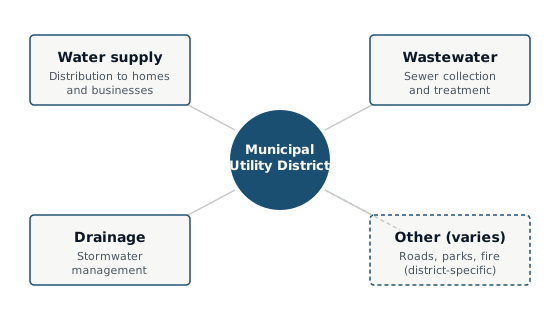
- Water supply and distribution
- Wastewater (sewer) collection and treatment
- Drainage and stormwater management
- In some districts: roads, parks and recreation, firefighting, or other authorized facilities (district-specific)
Important: Not every MUD provides the same mix. The Notice to Purchaser for a property lists the district’s stated purposes. Always check that notice and the district’s own materials for the parcel you care about.
Who governs a MUD?
A MUD is typically governed by a board of directors. Directors are usually elected by qualified voters in the district (rules and election timing are district- and law-specific). The board sets policy within its legal authority, including tax rate decisions on the schedule required by law, and oversees contracts for operations and construction.
Residents can often attend public board meetings, review agendas and minutes when published, vote in district elections when eligible, and contact the district’s operator or attorney for operational questions.
Participation looks different from city council life, but it is still public government. See Living in a MUD for practical next steps.

Texas framing (why you hear about MUDs so often)
Texas growth has long used special districts to extend utility infrastructure where traditional city service is not yet in place, or where cities and districts share overlapping arrangements. Some properties sit in a city’s extraterritorial jurisdiction (ETJ). Some districts have strategic partnership agreements with nearby cities. Annexation and overlap rules are legal topics. We stay high-level here and point you to official notices and licensed professionals for parcel-specific questions.
Primary sources to read next
- TCEQ Water Districts Map Viewer (opens official site)
- TAMU TRERC, “Clear as MUD”
- TREC Form 59-0, Notice to Purchaser
Common questions
What is a MUD district in Texas?
What is a MUD in real estate?
Is a MUD the same as the city?
Education only
Not legal, tax, or financial advice. Confirm details with your district and licensed professionals.
Related reading
Buying a home in a MUD · Living in a MUD · MUD taxes explained · MUD vs PID vs HOA